
We come across countless articles and posts created for patient education and oral-health awareness, but there is comparatively less short, practical content created specifically for us dentists.
Whenever I come across such content, I often visit the page or website to explore more. So, I thought of sharing a small piece of information for my fellow dentists.
There are so many materials used in dentistry. During my college days, Dental Materials was probably one of the subjects I found the most boring! 😅
But after starting clinical practice, I’ve realised how important it is to understand the materials we use in our everyday practice — not just their indications, but also their properties, advantages and limitations.
🦷 Calcium Hydroxide — A Quick Review
Calcium hydroxide is one of the most commonly used materials in endodontic and restorative dentistry. Historically, it has been extensively used in vital pulp therapy because of its biological properties.
Its activity is mainly attributed to the release of calcium (Ca²⁺) and hydroxyl (OH⁻) ions, which create a highly alkaline environment.
This high pH contributes to its antimicrobial activity and biological effects by:
• Creating an environment that is unfavorable for many microorganisms
• Disrupting bacterial cell membranes and cellular components
• Supporting hard-tissue formation and repair
• Promoting mineralization and tissue healing
calcium and hydroxide ions which an alkaline environment which neutralizes the acidic environment created by the microorganisms and helps healing , the ions reduces the bacterial concentration by disrupting the cytoplasmic membrane and damaging the bacterial DNA an sterilizes the site, it also induces formation of new tissue.
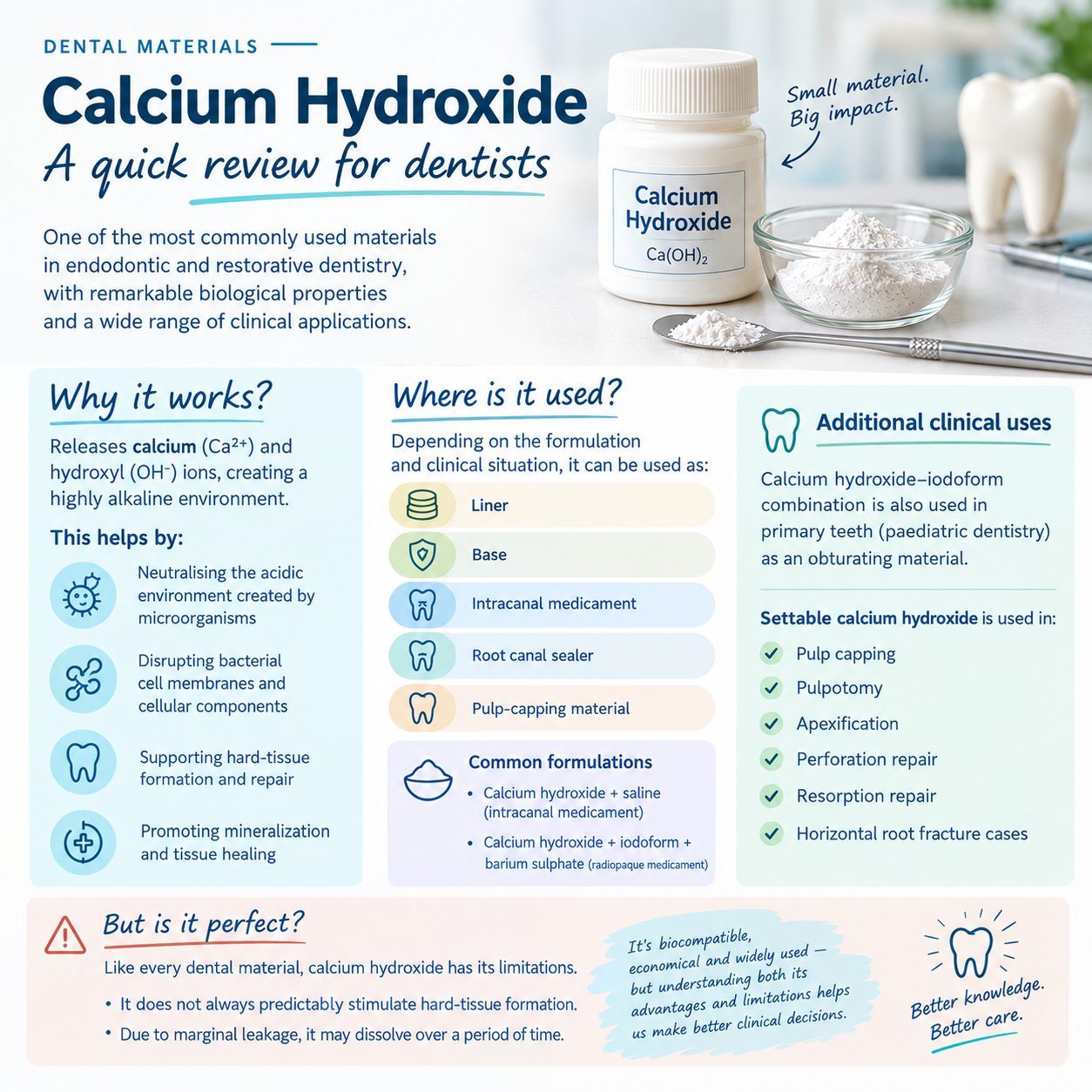
Where is calcium hydroxide used?
Depending on the formulation and clinical situation, calcium hydroxide can be used as:
🔹 Liner
🔹 Base
🔹 Intracanal medicament
🔹 Root canal sealer
🔹 Pulp-capping material
For intracanal medication, calcium hydroxide powder may be mixed with a suitable vehicle such as saline. Other formulations combine calcium hydroxide with ingredients such as iodoform and radiopaque agents.
In pediatric dentistry, calcium hydroxide–iodoform formulations are also used in the management of primary teeth.
Calcium hydroxide-based materials have applications in procedures such as:
• Pulp capping
• Pulpotomy
• Apexification
• Management of perforations
• Root resorption management
• Certain cases of horizontal root fracture
Calcium hydroxide is available in form of base and catalyst paste, light cure calcium hydroxide is also available which contains resins barium sulphate(composition of light cure calcium hydroxide can differ according to the manufacterer)
It is an biocompatible ,economical and widely used though every material have some disadvantages too it may not excusively stimulate tissue formation and may dissolve over a year at cavosurface marginal surface leakage.
But is calcium hydroxide perfect?
Like every dental material, calcium hydroxide has its limitations.
Although it has excellent biological and antimicrobial properties, it does not always predictably stimulate hard-tissue formation on its own. Its solubility can also become a concern, particularly when long-term sealing is required.
This is why understanding both the advantages and limitations of the materials we use is essential for making appropriate clinical decisions.
Sometimes, the material we studied as a “boring” subject in college becomes much more interesting once we start seeing its clinical relevance! 😄